

Research & Development Services
Research International performs contract research and development efforts and intellectual property development associated with our focus areas of custom instrumentation, optical sensing, micromachining and chemistry. The staff is composed of seasoned professionals, primarily from small product-oriented companies, who are well known for their expertise in developing creative and cost-effective solutions to difficult problems that span multiple disciplines. Factors such as market-driven design, ease of manufacture, and cost are always a consideration in their work.
In contrast to many R&D companies who are paper-oriented, Research International emphasizes hardware implementation of development results and so maintains a machine shop, a microfabrication lab, a chemistry lab, and optics/electronics design and assembly lab. The captive model shop provides hardware support for all development programs and includes a mechanical design group equipped for solid modeling and finite element analysis. Primary capital equipment in the machine shop includes four CNC milling centers, two manual mills, three lathes, and a 28-ton injection-molding machine. The microfabrication lab is used to produce thin-film and micromachined products and includes three deposition systems as well as the equipment necessary to go from design to wet-etched semi-conductor products. The chemistry lab is capable of performing standard organic, inorganic, and polymer chemistry laboratory techniques and also maintains modern analytical instrumentation. Developmental optics are supported by lens design, ray-tracing, and waveguide design software packages. Similarly, electronics systems are designed and tested in-house with circuit-board design and circuit emulation software. Assembly and troubleshooting are accomplished in the well-equipped electronics lab.
Scroll down to learn about the Hazard Card, FAST 2000, Ferret II and ChemCard are representative of the R&D projects performed by Research International. Each is a very small, self-contained instrument for detecting different hazardous materials and each was taken from conceptual design to manufacturing prototype in less than two years.
Legacy Products That Demonstate Our Capabilities
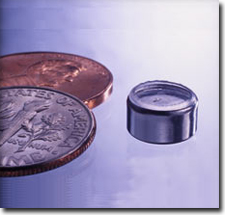
Model 845 Rechargeable Battery
The Model 845 battery is a 4 V rechargeable lithium-ion cell of novel design that is only 8 mm in diameter and 4.5 mm in height. The cell was developed under the auspices of the National Institute of Aging to enable a new generation of hearing aids that do not require regular battery replacement. The battery has a design life of about 1,500 charge/discharge cycles, equivalent to the average 4-year lifetime of a hearing aid, and does not suffer from memory effects common to other chemistries. It has a capacity of 10 mAh and can be discharged at rates of up to 10 mA. The 10 mAh capacity is sufficient to power a hearing aid for one day. A hearing aid based on this battery offers the advantages of: cost savings—no replacement batteries to purchase; ease of use—no small batteries to handle; safety—no small batteries swallow or insert in the ear. Additionally, the cell may be pulse-discharged at rates of 100–200 mA which offers the opportunity for exciting pulse power applications.
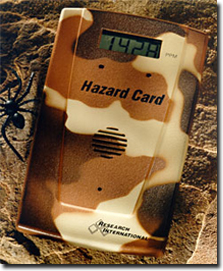
Hazard Card
Personal Monitor for the Detection of Exposure to Hazardous Gases
The Hazard Card provides a platform for a wide variety of sensor elements. Research International has worked primarily with chemiresistor and electrochemical sensors that can be incorporated into the device. These sensors are in different stages of development and promising results have been obtained. Hydrogen sulfide and carbon monoxide are considered the most common toxic gas hazards in confined spaces. The Hazard Card can be designed to sense either of these gases by selection of the appropriate detector. By incorporating two sensors, it will detect both of these toxic gases. The total system is powered by high-energy lithium primary cells.
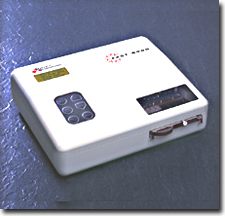
FAST 2000
Rapid, Portable, Fluorometric Assay System
The Flow Assay and Sensing System (FAST) is a second-generation instrument, developed under contract to the Naval Research Laboratory (NRL) as a rapid, portable system for performing flow immunoassays with detection limits to 1 part per billion. The FAST 6000 can be configured either as a single channel, single analyte instrument or as a six channel, six analyte instrument, capable of performing six simultaneous assays for six different analytes on the same sample. The system is completely self-contained, needing only a bottle of buffer and a waste bottle for field operation.
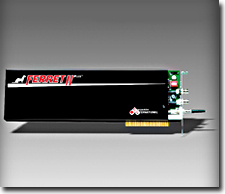
Ferret II
Spectral Scanning PC Card
Research International has developed a PC-based high-resolution, narrow waveband, spectral scanner, the Ferret II Plus, that is ideal for the interrogation of any single- or multi-mode fiber optic sensor with a reflectance spectrum containing one or more sharp lines. The Ferret works especially well with sensors based on fiber optic Bragg gratings. The card continuously scans the spectrum of a long-lived LED, used as the light source, and measures the wavelength of reflectance peaks found in the recovered signal. PC-resident software converts changes in the wavelength of these reflectance peaks into values of the measured parameter, based on a calibration curve, and displays the data in real time on the video display of the PC. The Ferret, using appropriate fiber sensors, has demonstrated the capability to monitor strain to levels below 1 microstrain, temperature to 0.05°C, and pressure to 0.025% of full scale.
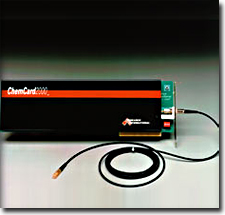
ChemCard 2000
The ChemCard2000 is an integrated fiber optic measurement system consisting of an opto-electronics interface on an ISA bus card and a software package for data acquisition and display. Any sensing method that changes its spectral characteristics in response to an analyte at the operating wavelengths of the ChemCard may be used. Prototype sensors have been developed at Research International for a number of analytes including pH, hydrogen gas, humidity, aromatic hydrocarbons, and temperature. The miniature optical pH sensor, based on pH dyes similar to those used in litmus paper, is available for industrial and biomedical applications. It operates via an immobilized indicator that is contained within a stainless steel microprobe 3.81 cm long and .033 cm in diameter.