

SASS® 4200 Vehicle-Mount Aerosol Concentrator
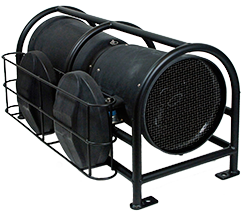 The SASS® 4200 Vehicle-Mount Aerosol Concentrator is a highly efficient, high-volume aerosol concentration device designed for vehicular applications. A blower-driven concentration device inside the unit pulls air in at a rate of about 4000 LPM (forward vehicle motion is not necessary for proper operation). Particulates in the sampled air are transferred to a low flow-rate secondary loop that can be routed to a location inside the vehicle. The unit is compatible with a wide variety of small portable samplers or bioanalyzers such as the SASS 2300, SASS 3100, or BioHawk.
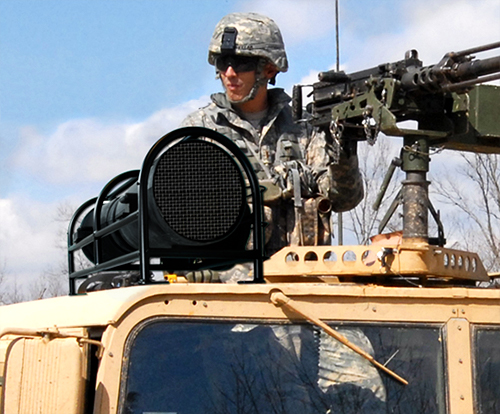
SASS 4200 Concentrator mounted on military vehicle
The secondary airflow containing the aerosol concentrate may range from about 1% to 10% of the primary flow. Operation at low secondary flows creates very high aerosol concentrations, while operation at higher secondary flow rates maximizes the total number of particulates captured.
View a short video showing how the SASS 4200 holds up to extreme water exposure.
DOWNLOAD DATA SHEET • REQUEST QUOTE
Product Features
- Roof mount
- Integrated aerosol concentrate inlet and outlet ports
- No moving parts, other than the primary fan
- Military-style electrical connector for power
- Minimal maintenance
- Wide operating temperature
- Clog resistant
Typical Applications
- Environmental
- Air quality
- Agriculture
- Public Health
- Medial facilities
- Homeland security
Resources
- Download SASS 4200 Vehicle Mount Data Sheet
- Influenza Virus Collection and Detection from Electret Filters - White Paper
- Candidate Disinfectants for Research International Products
- SASS Air Sampler Comparison Chart
- Bluetooth Biolink™ Wireless Units provide plug-and-play wireless communication between any Research International product and a remote PC or laptop.
Operational Details
How Does the Vehicle-Mount Concentrator Work?
The primary goal is to provide users with a highly efficient, rugged aerosol particle concentrator/collector that can be mounted onto either a civilian or military vehicle. By mounting only the rugged shock-mounted concentrator on the vehicle’s roof, ancillary equipment such as low volume samplers and bioanalyzers can be placed in a controlled environment within the vehicle while the concentrator performs the primary objective of external collection. In addition, a vehicle-mounted unit can also be rapidly deployed to different locations and can provide continuous sampling along a road or border while the vehicle is in motion.
The concentrated aerosol generated by the SASS 4200 is available at a nominal 48.3 mm circular port located under the unit, while a similar spigot near the rear of the unit is available for discharging concentrate air after it has been stripped of particles.
Particles are routed into the secondary flow by forcing primary circuit air to circulate through specially shaped channels where centrifugal force and particle momentum are used to isolate and concentrate the particles. The interior structure has been designed so that the smallest flow cross-section is a channel 0.6 mm wide x 6.35 cm long, providing good resistance to clogging by larger particles. A coarse screened cover with 5.4 mm square openings at the unit’s front inlet face further restricts the entrance of large debris.
While it is not recommended that the SASS 4200 be operated in the rain, tests have shown that the unit will tolerate the direct injection of up to 8 liters/minute of water into the inlet in the form of 1 to 2 mm nominal diameter water droplets. Core components within the external shroud are mounted in such a way that they can be easily removed for decontamination or replacement. Dust/rain caps are also provided for both the inlet and outlet faces for use when not sampling.
Specifications
SASS 4200 Vehicle-Mount Aerosol Concentrator Specifications
| Characteristic | Description |
|---|---|
| Primary airflow: | Up to 4000 liters/min is sampled at the inlet face and discharged at the rear outlet face. |
| Secondary airflow: | 40 – 360 LPM at +0.4 cm of water static head. |
| Secondary airflow connections: | 3.8 cm ID male hose fittings provided for aerosol concentrate output and secondary air exhaust. |
| Concentration enhancement: | 4 –15 times, typical, depending on primary/secondary air flow ratio. |
| Particle size rage: | 0.5 microns to 10 microns; for delivery to a wet or dry sampler such as the SASS 2300 or SASS 3100, respectively. |
| Overall size mounted in framework: | 481mm (19 in.) wide x 451mm (17.75 in.) high x 865mm (34 in.) long |
| Weight: | 16.3 kg (36 lbs.) |
| Operating temperature range: | -40°C to 60°C |
| Power requirements: |
|
| Electrical connection: | Military-style weatherproof connector. |
| Sound levels: | Measured at 1 meter distance - Front: 84 db; Side: 81 db; Rear: 87 db |
Research International reserves the right to change specifications without prior notice.
Parts and Accessories
SASS 4200 Wet Air Sampler Parts and Accessories
To request a price quote, check the box beside the desired item(s), fill out the form at the bottom of the page, and press Submit. We try to respond within two business days.