D1000 Downdraft Table
Protect Your Staff and Building from Mailborne Threats

The D1000 Downdraft Table is used wherever suspicious packages need to be examined that may contain toxic or flammable substances, explosives, drugs, or biological agents. A powerful downward current is created over the perforated inspection surface, directing air flow down and away from staff. Exhaust is channeled through a sophisticated series of filters to trap particles and prevent the spread of vapors and gases.
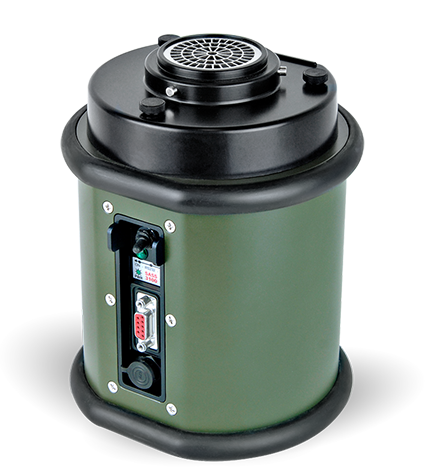
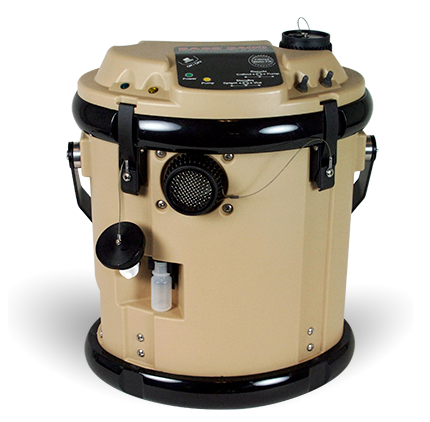
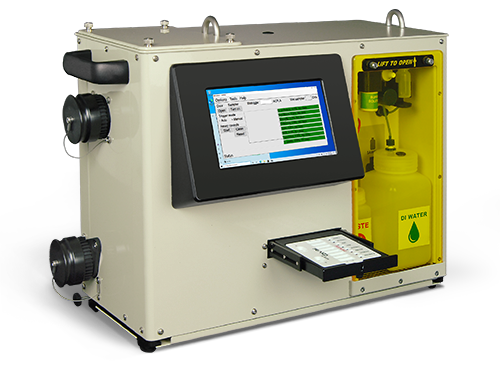
The D1000 is a key component of Research International’s ASAP III Postal Screening System. In addition to protecting personnel and facilities, it continuously collects and delivers samples for instant analysis by the ASAP III detection instruments. It is most often installed as part of a negative pressure room for maximum protection against mailborne hazards.
This product saves lives, protects buildings from contamination, and can improve inspection rates significantly.
The D1000 downdraft table is manufactured in accordance with U.S. Patent No. 7,377,952.
Keeping Staff and Workplace Safe
Protect Employees on the Front Line
A white powder or other CBRNe incident can be life-threatening. Keep your hardworking staff safe from threats like anthrax and ricin.
Avoid Costly Building Closures
A CBRN contamination incident can mean long-term facility closure, and the cleanup can cost millions. The D1000 helps contains the threat.
Customize and Integrate for Maximum Benefit
The D1000 can be manufactured to your specifications and optionally integrated into a full-scale screening system such as our ASAP III.
Product Features
Product Applications
Operational Details
Overview
Manual inspection processes involving the handling and opening of postal materials, shipping boxes, luggage, handbags, and packaged merchandise pose a risk to personnel during the inspection process and to the buildings in which the inspections are being done. If an article contains a biological agent, toxic chemical, or explosive or flammable material, many different types and levels of damage could occur if the material was indiscriminately released or not detected.
The D1000 downdraft table is a patented device1 designed to mitigate many of the life-threatening and/or infrastructure-damaging results of such hidden dangers and is of particular value to private and governmental postal inspection facilities.
Ref. 1: U.S. Patent No. 7,377,952.
Airflow & Filtration
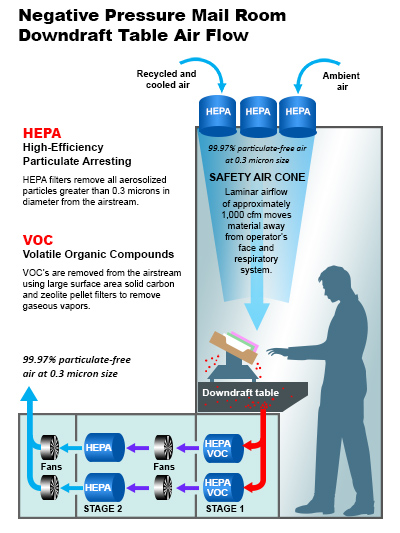
The D1000 table incorporates a perforated metal surface over which suspect articles are opened. Inside the table are powerful brushless motor-powered blowers that pull air downward into the table through the porous surface and through a 3-stage filtration system that removes large debris, respirable particulates, volatile organic hydrocarbons (VOCs), and odors.
- HEPA section removes all particulates > 0.3 µm with 99.97% efficiency.
- Hazardous materials in particulate form (e.g., chemicals, biologicals) are captured by the HEPA section and trapped within it.
- Low concentrations of many gases are stripped by the VOC filter; extremely high concentrations of toxic or explosive gases and vapors may optionally be exhausted to a remote safe area.
The D1000 has an airflow of about 28,000 L/min (≈1000 CFM) over each square meter of perforated surface, providing a strong downward air velocity of between 1.0 and 2.0 m/s.
Why Downdraft vs. Updraft
This approach is superior in many ways to examination systems based on upward-flowing laminar flow benches (“updraft tables”). If cover air is forced to flow upward, aerosol materials in the inspected articles will be broadly dispersed above the table surface, leading to possible contamination of the inspector’s upper torso, the inspection area, and nearby materials. Toxic or flammable gases will likewise be more broadly dispersed. The downdraft approach allows inspections to be done at low risk without the need for hot and uncomfortable face masks or protective suits.
CBRNE Monitoring Integration
The D1000 downdraft table may also be equipped with CBRNE monitoring equipment. Research International’s ASAP II and ASAP III threat detection systems are currently being used with D1000 tables in both government and private mail inspection facilities to monitor for a range of threat agents including biological agents, toxic chemicals, explosives, and nuclear materials. For this application, a proprietary sampling structure is employed that provides effective sampling across the entire table surface.