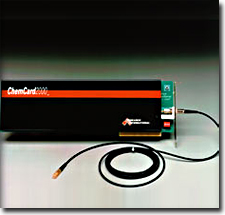
Research International performs contract research and development efforts and intellectual property development associated with our focus areas of custom instrumentation, optical sensing, micromachining and chemistry. The staff is composed of seasoned professionals, primarily from small product-oriented companies, who are well known for their expertise in developing creative and cost-effective solutions to difficult problems that span multiple disciplines. Factors such as market-driven design, ease of manufacture, and cost are always a consideration in their work.
In contrast to many R&D companies who are paper-oriented, Research International emphasizes hardware implementation of development results and so maintains a machine shop, a microfabrication lab, a chemistry lab, and optics/electronics design and assembly lab. The captive model shop provides hardware support for all development programs and includes a mechanical design group equipped for solid modeling and finite element analysis. Primary capital equipment in the machine shop includes four CNC milling centers, two manual mills, three lathes, and a 28-ton injection-molding machine. The microfabrication lab is used to produce thin-film and micromachined products and includes three deposition systems as well as the equipment necessary to go from design to wet-etched semi-conductor products. The chemistry lab is capable of performing standard organic, inorganic, and polymer chemistry laboratory techniques and also maintains modern analytical instrumentation. Developmental optics are supported by lens design, ray-tracing, and waveguide design software packages. Similarly, electronics systems are designed and tested in-house with circuit-board design and circuit emulation software. Assembly and troubleshooting are accomplished in the well-equipped electronics lab.
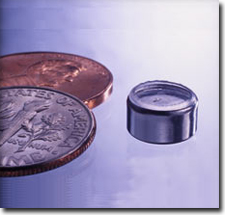
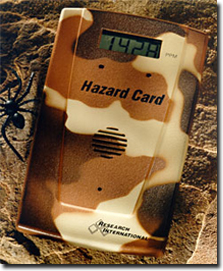
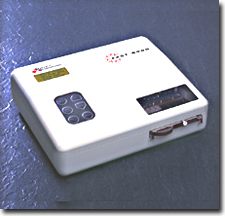
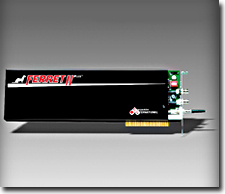
Scroll down to learn about the Hazard Card, FAST 2000, Ferret II and ChemCard are representative of the R&D projects performed by Research International. Each is a very small, self-contained instrument for detecting different hazardous materials and each was taken from conceptual design to manufacturing prototype in less than two years.