

Need help?
1-360-805-4930
RSN 5000
Remote Sensor Nodes for CBRN Monitoring

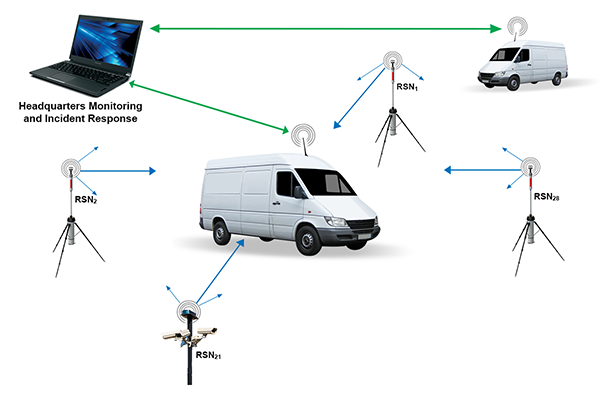
The RSN 5000 Remote Sensor Node is a portable CBRN monitoring device suitable for the detection of toxic gases, aerosolized biological agents, and nuclear materials. Some sensors are mounted within its tough cylindrical aluminum shell of 20 cm diameter and 1 meter height, while other sensors, such as video or thermal IR cameras, can be connected to the node via wireless. A built-in tripod is used to position the unit or alternatively, it may be secured to an adjacent structure using locking rings built into the exterior surface. Anti-theft features similar to those used for automobiles have been incorporated due to their portability. Data gathered by a unit can be wirelessly transmitted to a remote local receiver positioned up to 2 km away. Collected data from multiple nodes may be transferred to a headquarters location 50-70km distant using commercial RF digital transceivers.
Wide-area portable CBRN monitoring
Protection for mass gatherings
The RSN 5000 system can be deployed quickly and easily to monitor large-scale occasions like sporting events, outdoor concerts, or political rallies.
Rapid deployment for changing situations
The RSN 5000 is designed for use anywhere and can operate 12 hours on battery power. The control center can be installed in a vehicle for ultimate mobility.
Scalable, networkable, and customizable
As many as 64 nodes can be networked for maximum coverage of wide areas. Modular design ensures your system will be built with the right sensors for your application.
Product Features
Full CBRN monitoring capability and GPS location
200 LPM air sampling rate
Sample collection upon alarm
Optional weather station and video!
Portable: 12 hours on battery power
High speed 100 MHz wireless network
2 km range, up to 64 nodes per network
Network operating software - no license fee
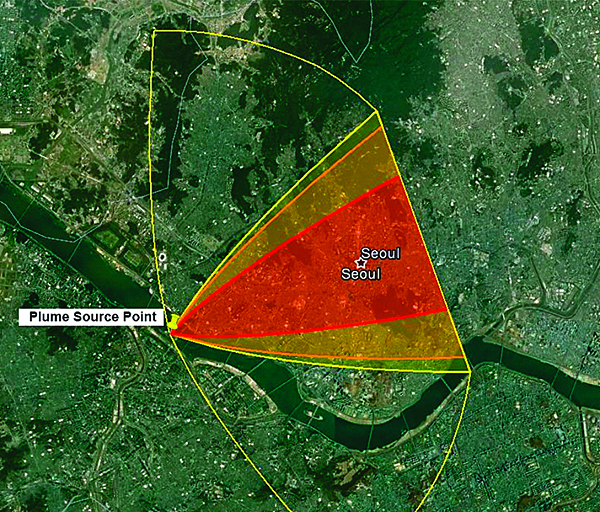
Plume dispersion software
Applications
Public spaces such as sporting events
Homeland security
Military
Power plants
Environmental monitoring


Operational Details
Overview
Research International’s Remote Sensor Node is a portable CBRN monitoring device suitable for the detection of toxic gases, aerosolized biological agents, and nuclear materials. Some sensors are mounted within its tough cylindrical aluminum shell of 20 cm diameter and 1 meter height, while other sensors, such as video or thermal IR cameras, can be connected to the node via wireless. A built-in tripod is used to position the unit or alternatively, it may be secured to an adjacent structure using locking rings built into the exterior surface. Anti-theft features similar to those used for automobiles have been incorporated due to their portability. Data gathered by a unit can be wirelessly transmitted to a remote local receiver positioned up to 2 km away. Collected data from multiple nodes may be transferred to a headquarters location 50–70 km distant using commercial RF digital transceivers.
Airflow & Sampling
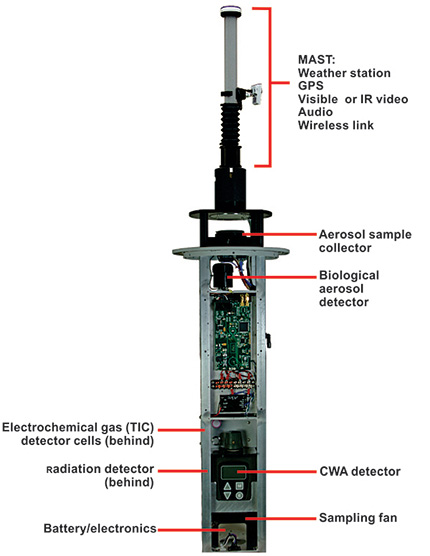
Air is drawn into the unit through a top cap at the rate of 200 liters/minute and discharged through a perforated cylindrical exhaust section near the unit’s base. The unit is modular in design, and depending on customer preferences, sampled air can be examined for various types of threats:
- Toxic gases can be detected by one or more of four state-of-the-art methods;
- Bioaerosols can be detected by an ultraviolet fluorescence-based biodetector designed to recognize suspicious changes in bioaerosol concentrations; and
- Radiation can be detected by a sensitive gamma ray radiation detector capable of evaluating suspicious changes in background radiation levels.
Automatic Secondary Sampling
If user-adjustable alarm levels are exceeded, a secondary sampling circuit can be automatically activated that collects a permanent aerosol particle sample onto a special high-efficiency filter element. The materials collected on this filter can then be examined using either rapid response portable or laboratory-grade biological, chemical or radiological assay protocols.
Mounting & Internal Components

Portable Weather Station
A portable weather station is available that can be rapidly mounted to the unit and deployed to a height of 3 meters. If a toxic incident is encountered, the weather station provides invaluable information on wind speed and direction as well as GPS location, temperature and relative humidity. This information is needed to predict how the toxic material will disperse in the atmosphere and if crowds or population need to be moved to put them out of harms’ way. Detection of a toxic incident is only the first step in minimizing its impact.
Cameras & Remote Gas Detector
A high resolution video or thermal IR camera may also be associated with the Remote Sensor Node, either being physically mounted to it or placed at a location with good visibility and electronically connected to it by a wireless link. This optional feature is highly recommended as it can be used to monitor a large area for suspicious individuals and can be a deterrent for a wide range of terrorist activities. An area-monitoring gas detector is also available that can be remotely located and connected by wireless link.
ASAP Sentry™ Software
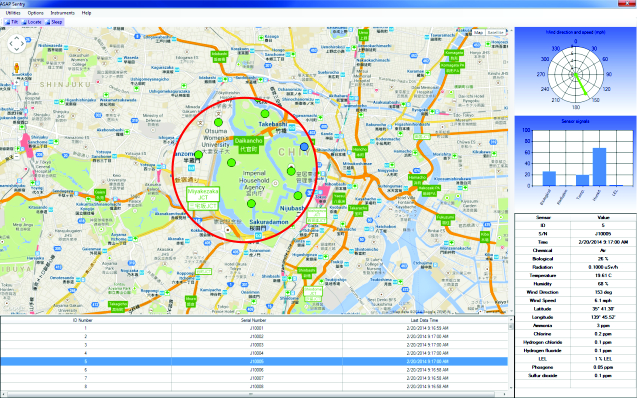
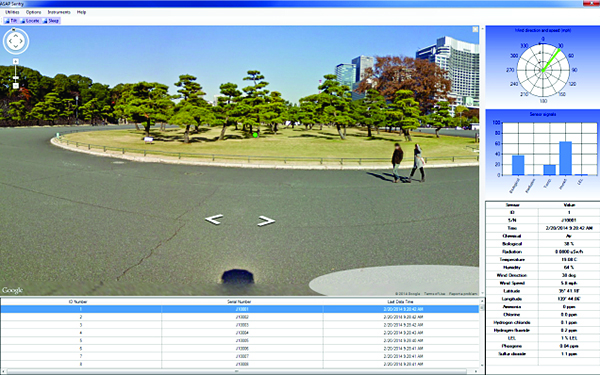
ASAP Sentry™ software is available for integrating the data from multiple Remote Sensor Nodes onto maps of the local area and for predicting toxic plume concentrations and movement based on weather data provided by the portable weather station or by local meteorological stations. These models have been developed by the U.S. government for use by its municipalities.
Robotic Deployment
The unit may also be mounted to a robot for semi-automated deployment. This allows the sensor module to be rapidly moved from place to place. If a toxic event occurs, one robotic detection unit is capable of creating a detailed picture of the toxic plume’s concentration and movement by being positioned for short periods of time at a number of points within the plume’s downwind profile. This can create a rich actionable database not possible with fixed location devices. The robotic device is capable of operation in areas far too toxic or with radiation levels too high to be tolerated by emergency personnel.
Mobile Systems

Research International can also furnish complete turn-key systems for use with vehicles. These systems can be designed to function as local area network monitoring points or mobile sensor platforms, or both. In a typical case, a van will be equipped with built-in desks, storage areas for sensors and protective suits, auxiliary generator and power points, external antenna mounts, air conditioning, etc. If the van is to be used in hostile environments, both the front driving cab and rear work areas can be hermetically sealed to protect drivers and other personnel from exposure to toxic materials surrounding the vehicle.


